CM Health Insurance
Introduction
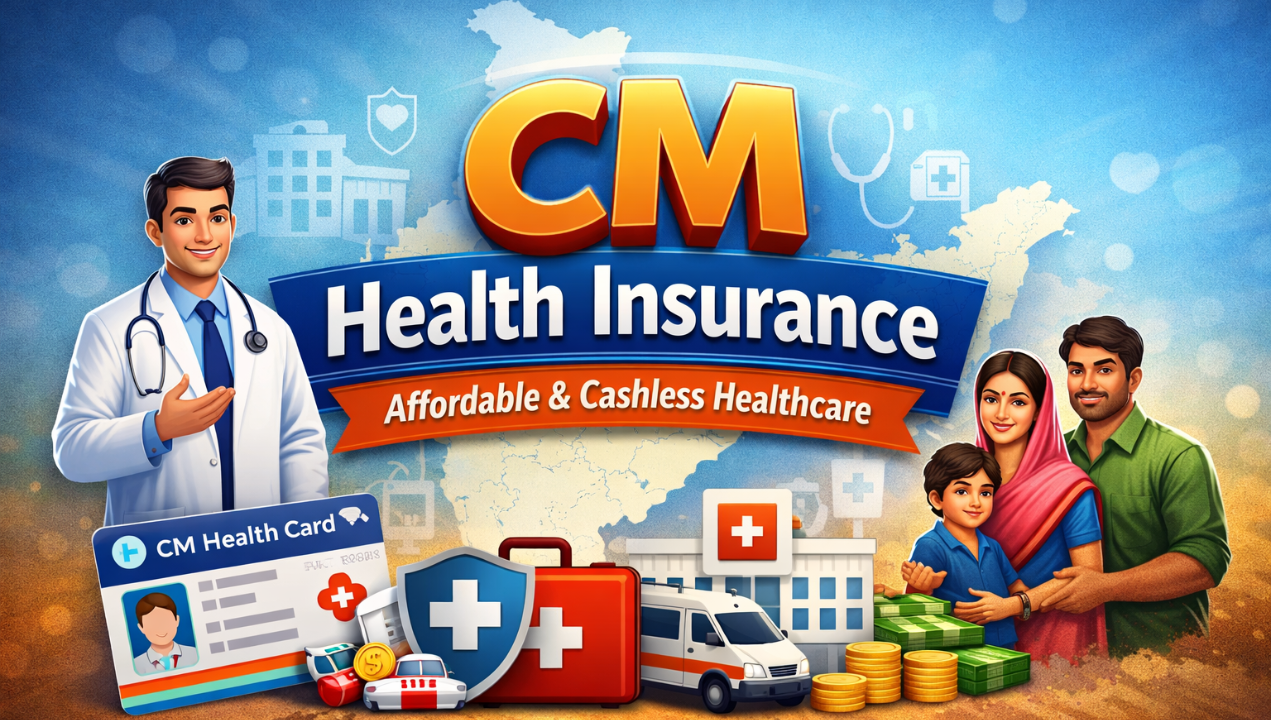
CM Health Insurance refers to health insurance schemes launched by various State Governments in India under the leadership of the Chief Minister. These schemes aim to provide financial protection against medical expenses and ensure that citizens, especially economically weaker and vulnerable sections, can access quality healthcare without facing heavy financial burdens.
Healthcare costs in India are rising rapidly, and many families are pushed into debt due to hospital expenses. To address this problem, several state governments have introduced CM Health Insurance schemes that offer cashless treatment at government and empanelled private hospitals. These schemes play an important role in strengthening public healthcare and improving overall health security.
What is CM Health Insurance?
CM Health Insurance is a state-sponsored medical insurance program that provides health coverage to eligible residents of a particular state. The scheme is funded by the state government and implemented through insurance companies or government agencies.
Each state designs its own version of CM Health Insurance with different names, benefits, and coverage limits. However, the main objective remains the same:
to reduce out-of-pocket medical expenses and provide access to essential and advanced healthcare services.
In many states, CM Health Insurance works in coordination with national schemes such as Ayushman Bharat – PM Jan Arogya Yojana (PM-JAY) to extend wider coverage.
Objectives of CM Health Insurance
The main objectives of CM Health Insurance are:
- To provide financial protection against major medical expenses.
- To ensure cashless hospital treatment for eligible families.
- To improve access to quality healthcare in rural and urban areas.
- To support treatment for serious and life-threatening diseases.
- To reduce poverty caused by high healthcare costs.
- To strengthen the healthcare system through empanelled hospitals.
Key Features of CM Health Insurance
CM Health Insurance schemes generally include the following features:
1. Cashless Treatment
Beneficiaries can receive treatment without paying money at the hospital counter. The insurance company directly settles the bill with the hospital.
2. Family Floater Coverage
Most schemes provide coverage for the entire family under a single policy. This means one sum insured can be used by any family member.
3. Annual Coverage Limit
The coverage amount depends on the state. It may range from ₹5 lakh to ₹10 lakh or more per family per year.
4. Wide Hospital Network
Treatment is available at government hospitals and selected private hospitals that are officially empanelled under the scheme.
5. Coverage for Major Diseases
The scheme usually covers:
- Surgeries
- Hospitalisation
- Diagnostic tests
- Dialysis
- Cancer treatment
- Heart surgery
- Orthopaedic procedures
- Maternity-related complications (in some states)
6. No or Very Low Premium
Most CM Health Insurance schemes are fully funded by the state government, so beneficiaries do not have to pay any premium or pay only a nominal amount.
Medical Expenses Covered
CM Health Insurance generally covers:
- Hospital room charges
- Doctor’s consultation fees
- Surgery and operation charges
- ICU and emergency services
- Diagnostic tests like X-ray, MRI, CT scan
- Pre-hospitalisation and post-hospitalisation expenses (for a limited period)
- Medicines during hospital stay
Some schemes also cover high-cost treatments such as:
- Kidney transplant
- Chemotherapy
- Bypass surgery
- Neurosurgery
The exact list of covered treatments depends on the state policy.
Who is Eligible for CM Health Insurance?
Eligibility conditions differ from state to state, but common criteria include:
- The applicant must be a permanent resident of the state.
- The family should belong to a low-income group or specific category such as BPL (Below Poverty Line).
- Aadhaar card or any valid government ID is required.
- Ration card or income certificate may be needed.
- Some states also include government employees, pensioners, or specific occupational groups.
Documents Required
Commonly required documents include:
- Aadhaar card
- Ration card
- Residence proof
- Income certificate
- Family details
- Passport-size photographs
- Mobile number linked with Aadhaar
How to Apply for CM Health Insurance
The application process varies by state but usually includes:
Online Application
Applicants can visit the official state health insurance portal and:
- Fill the application form
- Upload required documents
- Verify mobile number
- Submit the form
Offline Application
Applicants can also apply through:
- Government hospitals
- Common Service Centres (CSC)
- Health camps organised by the government
After approval, beneficiaries receive a Health Insurance Card or CM Health Card which can be used at empanelled hospitals.
How to Use CM Health Insurance
To use the scheme:
- Visit an empanelled hospital.
- Show your CM Health Insurance card or Aadhaar card.
- The hospital verifies your eligibility.
- Treatment is provided on a cashless basis.
- The hospital submits the claim directly to the insurance provider.
Benefits of CM Health Insurance
- Reduces financial burden on poor families
- Provides access to quality healthcare
- Encourages early diagnosis and treatment
- Supports treatment of critical illnesses
- Improves public health outcomes
- Strengthens healthcare infrastructure
Challenges and Limitations
Despite its benefits, CM Health Insurance has some limitations:
- Limited hospital network in remote areas
- Some treatments may not be covered
- Awareness among rural population is still low
- Delays in claim processing in some cases
Governments are continuously working to improve these issues by increasing coverage and hospital networks.
Future of CM Health Insurance
In the coming years, CM Health Insurance schemes are expected to:
- Increase coverage limits
- Include more diseases
- Add more private hospitals
- Use digital health cards
- Integrate with national health systems
These improvements will make healthcare more accessible and affordable for millions of citizens.
Here are some official or government links related to CM Health Insurance / Chief Minister Health Insurance Schemes in India that you can refer to:
🔗 Nagaland Chief Minister Health Insurance Scheme (CMHIS) official website:
https://cmhis.nagaland.gov.in/
🔗 Tamil Nadu Chief Minister’s Comprehensive Health Insurance Scheme (CMCHIS) official portal:
https://m.cmchistn.com/
Frequently Asked Questions (FAQs)
Q1. What is CM Health Insurance?
CM Health Insurance is a health insurance scheme launched by a state government under the leadership of the Chief Minister to provide affordable and cashless medical treatment to eligible citizens.
Q2. Is CM Health Insurance free?
In most states, CM Health Insurance is completely free for beneficiaries as the government pays the premium.
Q3. Who can apply for CM Health Insurance?
Residents of the state who meet income and eligibility criteria can apply. This usually includes low-income families and vulnerable groups.
Q4. How much coverage is provided?
Coverage depends on the state scheme and may range from ₹5 lakh to ₹10 lakh per family per year.
Q5. Can I use CM Health Insurance in private hospitals?
Yes, treatment can be taken in government hospitals and selected private hospitals that are empanelled under the scheme.
Q6. What diseases are covered?
Most schemes cover major illnesses such as cancer, heart disease, kidney problems, surgeries, and hospitalisation expenses.
Q7. How can I apply for CM Health Insurance?
You can apply online through the official state portal or offline at government hospitals or CSC centres.
Q8. Is Aadhaar mandatory for CM Health Insurance?
In most states, Aadhaar is required for identification and verification purposes.
Q9. Can the same family use the insurance multiple times in a year?
Yes, the family can use the insurance multiple times as long as the total claim amount does not exceed the annual coverage limit.
Q10. What should I do if my claim is rejected?
You can contact the helpline number provided by the state government or visit the nearest health office for grievance redressal.
Q11. Is CM Health Insurance linked with Ayushman Bharat?
In many states, CM Health Insurance is integrated with Ayushman Bharat to provide extended coverage.
Q12. Can senior citizens apply for CM Health Insurance?
Yes, senior citizens who meet eligibility criteria can apply and receive treatment benefits.
Conclusion
CM Health Insurance is an important step towards achieving universal healthcare coverage in India. By offering cashless and affordable treatment, these schemes protect families from financial distress and improve their quality of life. Although challenges remain, CM Health Insurance continues to evolve and expand, making healthcare more accessible for millions of people across the country.
With increasing awareness and better implementation, CM Health Insurance can play a major role in building a healthier and stronger society.

YojanaVichar.com एक डिजिटल प्लेटफ़ॉर्म है जो भारत की केंद्र और राज्य सरकार की योजनाओं, कल्याण कार्यक्रमों और जन पहल से जुड़ी नवीनतम जानकारी और मार्गदर्शन प्रदान करता है। इसका उद्देश्य नागरिकों को सही व विश्वसनीय जानकारी देकर सशक्त बनाना है। यहाँ योजनाओं की पात्रता, लाभ, आवेदन प्रक्रिया और आधिकारिक सूचनाएँ सरल भाषा में उपलब्ध कराई जाती हैं। यह प्लेटफ़ॉर्म नियमित अपडेट और तथ्य-जाँच के साथ नागरिकों तक नीतिगत जानकारी पारदर्शिता से पहुँचाता है।