National e-Governance Division (NeGD): Role, Functions and Responsibilities
The National e-Governance Division (NeGD) was established in 2009 by the Ministry of Electronics and Information Technology (MeitY), Government of India. It was created as an independent business division under the Digital India Corporation, formerly known as Media Lab Asia, which is a Section 8 not-for-profit company. The primary objective behind the creation of NeGD was to provide dedicated institutional support for the planning, implementation, and management of large-scale e-Governance initiatives across India.
Since its establishment, NeGD has played a pivotal role in assisting MeitY in programme management and execution of various e-Governance projects. It provides technical and advisory support to ministries and departments at both the central and state levels, as well as to other government organizations. NeGD functions as a key enabler of India’s Digital India vision by strengthening digital governance systems and improving public service delivery through technology.
NeGD’s major operational areas include programme management, project development, technology management, capacity building, and awareness and communication activities under the flagship Digital India Programme. Through these functions, NeGD ensures that digital initiatives are designed, implemented, and monitored in a structured and standardized manner.
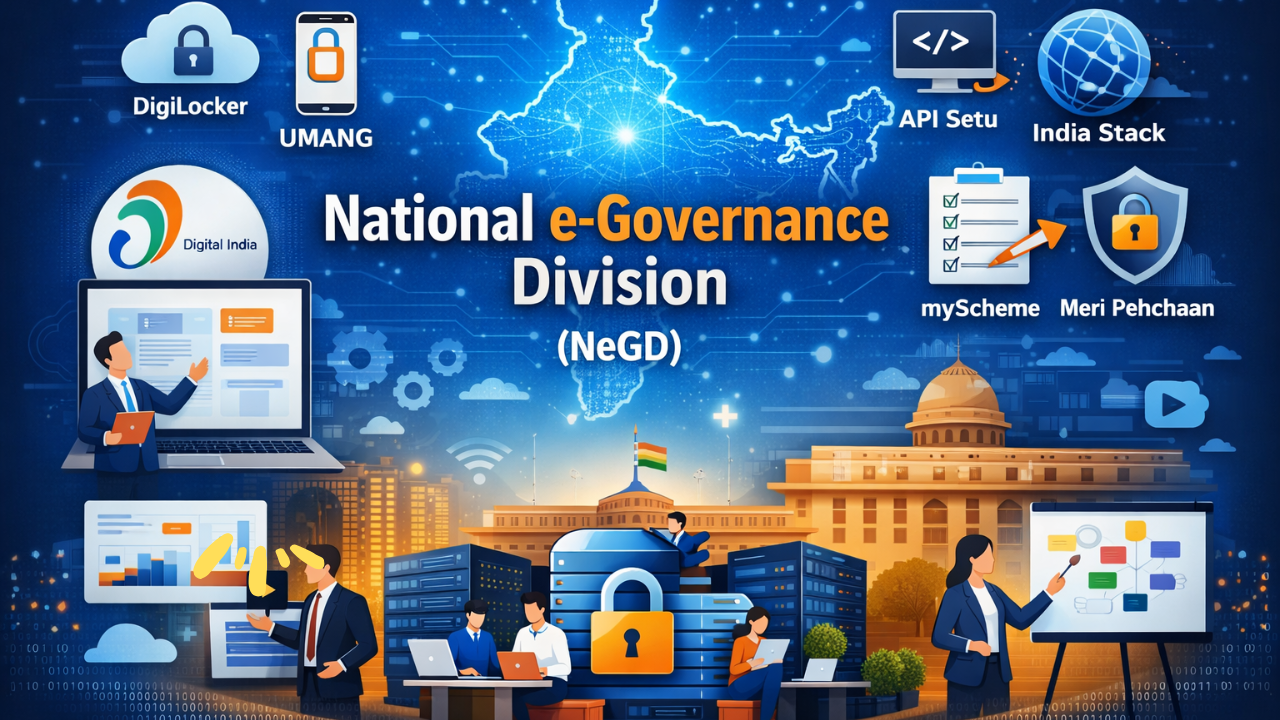
Over the years, NeGD has developed and managed several National Public Digital Platforms that serve millions of citizens and institutions across the country. These platforms include DigiLocker, which enables secure digital storage of documents; Entity Locker, which provides digital document services for organizations; UMANG, a unified mobile application for accessing government services; OpenForge, a collaborative platform for open-source development; API Setu, which acts as a bridge for application programming interfaces of government services; myScheme, a national platform to discover government welfare schemes; India Stack Global, which promotes India’s digital public infrastructure internationally; Meri Pehchaan, a national single sign-on system; and UX4G, which focuses on improving user experience in government digital services.
The envisioned roles and responsibilities of NeGD are wide-ranging and strategic in nature. One of its core responsibilities is to provide strategic direction for framing policies and implementation strategies for the Digital India Programme and various e-Governance projects across different domains. NeGD also offers technical and advisory support to central and state governments for mission mode projects and other digital governance initiatives.
Another important function of NeGD is the technical appraisal of e-Governance projects. This involves examining critical aspects such as overall technology design, system architecture, frameworks, standards, security policies, service delivery mechanisms, and the use of common infrastructure. By doing so, NeGD ensures that government digital systems are secure, scalable, and interoperable.
NeGD also supports the development of national frameworks and guidelines, including the India Enterprise Architecture Framework and Digital Service Standards. These frameworks help maintain uniformity, efficiency, and quality in government digital services. Capacity building is another major responsibility of NeGD. It focuses on strengthening the skills of government officials in the areas of e-Governance and emerging technologies such as artificial intelligence, the Internet of Things, drones, and geospatial technologies.
Ensuring effective citizen engagement and communication is also part of NeGD’s mandate. It uses both offline methods and social media channels to interact with stakeholders and spread awareness about digital initiatives. In addition, NeGD undertakes impact assessment and e-readiness measurement of e-Governance projects to evaluate their effectiveness and identify areas for improvement.
NeGD is also responsible for the recruitment, deployment, and human resource management of specialized professionals working in State e-Governance Mission Teams across all states and Union Territories. Knowledge management and sharing of best practices form another crucial area of its work. This is achieved through workshops, preparation of case studies, and the creation of knowledge repositories that support learning and innovation in digital governance.
Through these roles and activities, the National e-Governance Division acts as a bridge between policy formulation and practical implementation. It strengthens coordination between central and state governments and ensures that digital technologies are effectively used to promote transparency, efficiency, and citizen-centric governance.
Here’s the official website link you can use in your article:
🔗 Official NeGD Website: https://negd.gov.in/
Frequently Asked Questions (FAQs)
Q1. What is the National e-Governance Division (NeGD)?
NeGD is an organization established in 2009 by the Ministry of Electronics and Information Technology to support and manage e-Governance and Digital India initiatives in India.
Q2. Under which organization does NeGD operate?
NeGD functions as an independent business division under the Digital India Corporation, formerly known as Media Lab Asia.
Q3. Which ministry oversees NeGD?
NeGD is overseen by the Ministry of Electronics and Information Technology (MeitY), Government of India.
Q4. What are the main operational areas of NeGD?
Its main operational areas include programme management, project development, technology management, capacity building, and awareness and communication activities under the Digital India Programme.
Q5. Name some major digital platforms managed by NeGD.
Major platforms include DigiLocker, Entity Locker, UMANG, OpenForge, API Setu, myScheme, India Stack Global, Meri Pehchaan, and UX4G.
Q6. How does NeGD support central and state governments?
NeGD provides technical guidance, advisory services, project appraisal, and implementation support for mission mode and other e-Governance projects.
Q7. What is the role of NeGD in policy and framework development?
NeGD helps in developing frameworks and guidelines such as the India Enterprise Architecture Framework and Digital Service Standards for uniform digital governance.
Q8. Does NeGD work on capacity building?
Yes, NeGD conducts training and skill development activities for government officials in e-Governance and emerging technologies like AI, IoT, drones, and geospatial technologies.
Q9. What is NeGD’s role in citizen engagement?
NeGD ensures effective communication with citizens and stakeholders through offline outreach and social media channels.
Q10. Why is NeGD important for Digital India?
NeGD is important because it provides institutional, technical, and strategic support for implementing Digital India initiatives and strengthening digital governance across the country.

YojanaVichar.com एक डिजिटल प्लेटफ़ॉर्म है जो भारत की केंद्र और राज्य सरकार की योजनाओं, कल्याण कार्यक्रमों और जन पहल से जुड़ी नवीनतम जानकारी और मार्गदर्शन प्रदान करता है। इसका उद्देश्य नागरिकों को सही व विश्वसनीय जानकारी देकर सशक्त बनाना है। यहाँ योजनाओं की पात्रता, लाभ, आवेदन प्रक्रिया और आधिकारिक सूचनाएँ सरल भाषा में उपलब्ध कराई जाती हैं। यह प्लेटफ़ॉर्म नियमित अपडेट और तथ्य-जाँच के साथ नागरिकों तक नीतिगत जानकारी पारदर्शिता से पहुँचाता है।